What is the 9-grid and how do you apply it in workforce management?

Planning your workforce is important. But real progress only comes when you also know who is performing well, who is ready for a next step, and who contributes positively to collaboration within the team. That is precisely where the 9-grid helps. It provides a visual overview of your employees, enabling you to steer development, succession, and how people are deployed across the organisation.

Background glow

What is the 9-grid model?

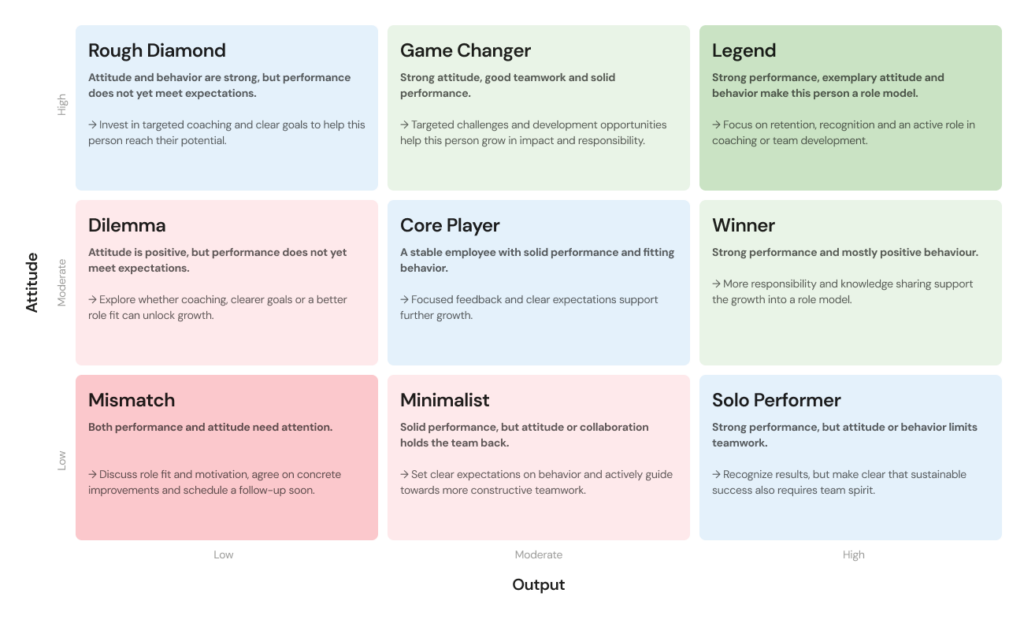
The 9-grid is an assessment model with which you assess employees on two dimensions. Based on that assessment, employees are visually distributed within a matrix, so you can quickly see how someone is developing and how they compare to others within the team. The aim of this assessment is to provide a clear picture of strengths, development opportunities, and areas for attention. In this way, the 9-grid is above all a practical conversation tool for targeted development discussions and better decision-making on the shop floor.

The model was developed by McKinsey to give organisations a strategic tool for gaining insight into employee performance. This traditional 9-grid model looks at performance versus potential. Dyflexis has developed a variant of this that is better suited to non-desk and frontline employees: performance versus attitude & behaviour. This means you look not only at what someone achieves, but also at how they collaborate, take responsibility, step in when needed, and contribute to stability and reliability within the team.
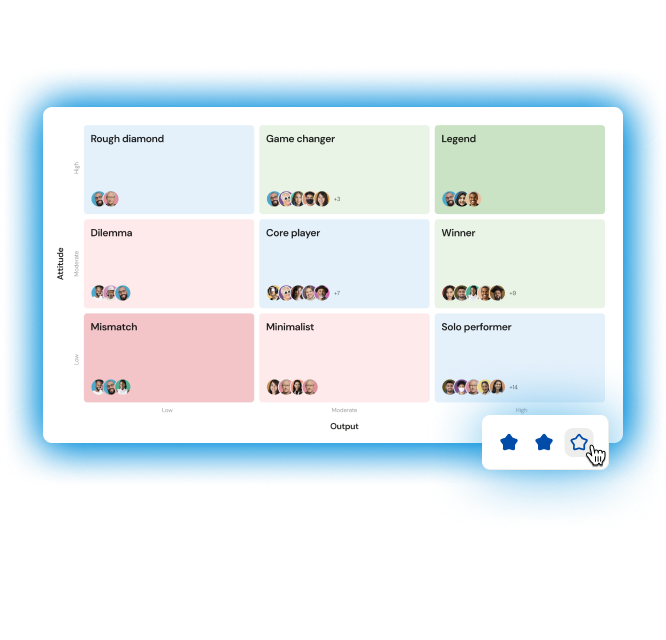
Both axes have three levels: low, average, and high. This creates nine boxes. The second axis is deliberately different from the traditional model. For many frontline roles, ‘potential’ is difficult to assess objectively, whereas attitude and behaviour are visible every day. They manifest in practice: keeping to agreements, supporting colleagues, remaining reliable during peak moments, radiating calm, taking responsibility, and fitting in with the way the team works together. This is not without consequence; it has a direct impact on performance, team dynamics, and the customer experience.

Performance: how does the employee perform?

Attitude & Behaviour: collaboration and role within the team

Background glow

What can I use the 9-grid for?

You use the 9-grid to make talent concrete and open a discussion. It supports talent management, succession planning, development conversations, and making targeted decisions about coaching, training, or progression. Because you visually categorise employees, you can more quickly see where growth potential lies, where risks exist, and where you have reliable people on whom you can depend.

The real strength lies in the combination of the model and the conversations it prompts. The model does not help you to “box people in”, but to ask better questions. Is someone performing well, but causing friction within the team? That is not a minor detail, but relevant management information. And is someone not yet delivering the highest results, but working reliably, learning quickly, and strengthening the group? Then there may be considerable potential there.
Background glow

How do you use the 9-grid in practice?

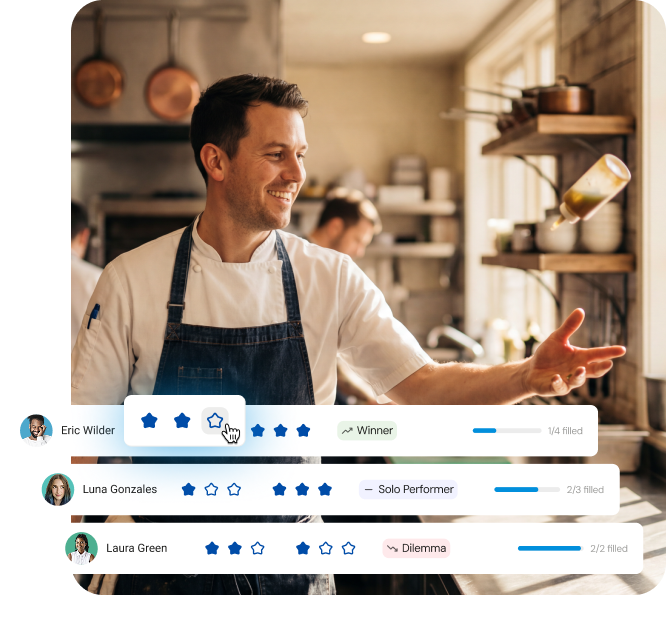
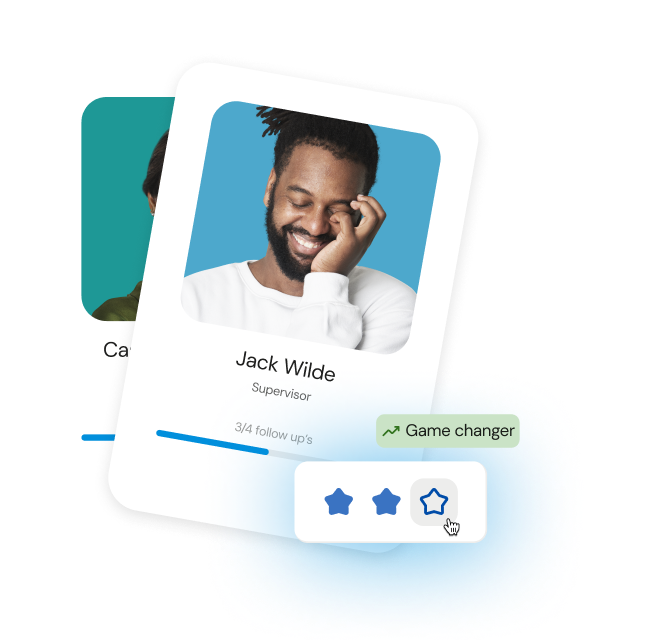
In practice, managers do not work by manually placing employees into a box in the 9-grid themselves. Instead, they provide an assessment for each employee on the two axes: performance and attitude & behaviour. For both dimensions, they give 1, 2, or 3 stars. Based on these scores, the employee is automatically placed in the correct box of the 9-grid.

This makes the model accessible and quick to use. Managers do not need to write extensive explanations or lengthy assessments on paper, but can simply record their assessment in a straightforward way. That is precisely a major advantage in practice: it takes little time, is easy to complete, and produces a clear, visual overview of the team.

The strength of the 9-grid lies not only in the outcome, but above all in the conversations that follow. The scores and position in the matrix form the starting point for discussions between managers and employees about performance, attitude, collaboration, development, and possible next steps. By repeating this periodically, you can also clearly track how employees are developing and whether they shift position within the matrix over time.

The strength of the 9-grid lies not in the outcome, but in the conversations that follow.
What are the benefits of the 9-grid?

Simple assessment:
no paperwork

Managers can assess employees quickly without lengthy forms, extensive reports, or separate notes. By giving a score for performance and attitude & behaviour, a clear picture emerges straight away. This saves time and makes the assessment process accessible enough to carry out on a regular basis.

A complete overview of the organisation

By looking at performance and attitude & behaviour, you gain a more complete picture of employees, teams, and departments. You can see not only who is performing well, but also who contributes positively to collaboration. In this way, you gain a grip on the quality of an entire department or even the whole organisation in a single overview.

Discover the
changes and gaps

Because the 9-grid is quick and straightforward to complete, you can repeat the process more frequently. Some organisations do this every quarter. As a result, you can more quickly identify which employees are developing, falling back, or in need of extra attention. This allows you to intervene earlier and have more targeted conversations.

Would you like to use the 9-grid successfully within your organisation? We would be happy to speak with you to work together on an approach that suits your teams and way of working.

Skills management: the key to better planning and stronger performance

Organisations that grow, will sooner or later face the same question: how do you ensure that your employees are not only deployed efficiently, but also utilised to their full potential? At first, this seems straightforward. You know your team, you understand what people are good at, and you distribute work based on experience and instinct. But as teams grow, roles evolve and the pressure to deliver quality increases, this becomes increasingly difficult. That is when the need for something different arises: oversight. Not just in planning, but in skills. And that is precisely where skills management comes into play.

Background glow

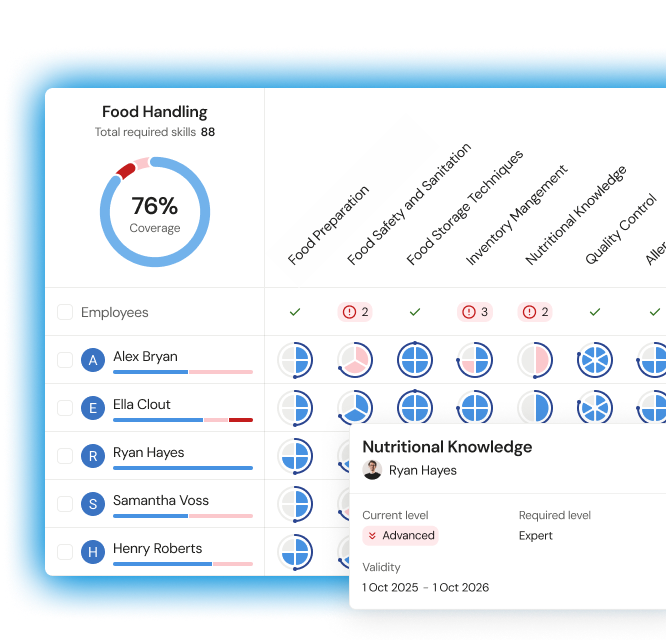
In many organisations, a great deal of information about employees is already available. Think of contracted hours, availability, job roles, and performance. But one crucial element is often missing or fragmented: a clear picture of skills.

  • Which skills are present within the team?
  • At what level are they mastered?
  • And how does that relate to what the organisation needs?

Without that insight, a large part of your workforce remains underutilised. Not because people are incapable of more, but simply because it is not visible. Skills management makes it visible. It brings structure to something that is often implicit. It translates knowledge and experience into concrete, actionable insights. And that forms the foundation for better decisions.

From an overview of people to insight into skills

Background glow

Why skills management makes organisations stronger

When organisations have a thorough picture of their skills, the way they make decisions changes. Decisions become less reliant on gut feeling and more grounded in insight. Managers gain a clearer view of their team. HR can direct development more purposefully. And operations can better assess where risks or opportunities lie. This is reflected across multiple aspects of the organisation. Teams are assembled more effectively, because it is clear which skills complement one another. Employees are deployed more purposefully, leading to improvements in both quality and efficiency. And development gains more direction, because it becomes visible where growth is possible.

Perhaps even more importantly: talent becomes more visible. In many organisations, employees are capable of far more than their current role reveals. Once that insight is available, new opportunities arise for advancement, broadening of responsibilities, and more effective deployment.

Background glow

One of the greatest changes that skills management brings about is that implicit knowledge is made explicit. Where managers previously relied on experience (“I know who can handle this”), there is now a shared and more objective picture. This not only creates greater consistency, but also enables better collaboration between departments and locations.

It makes organisations less dependent on individual knowledge, and therefore more scalable. At the same time, it becomes easier to look ahead. When you know which skills are present and which are lacking, you can steer towards the future more purposefully. For example, by investing in training in a timely manner, by developing internal talent, or by recruiting in a targeted way.

From gut feeling to concrete direction

Background glow

Skill gaps as a compass for growth

A key component of skills management is insight into skill gaps: the difference between the skills you have and the skills you need. That insight acts as a compass. It shows where the organisation can grow and where it may be vulnerable. Not only at an individual level, but particularly at team and organisational level as well. Rather than reacting when something goes wrong, you can take a proactive approach. You know where reinforcement is needed, where knowledge is too narrowly distributed, and where development will have the greatest impact. This makes skills management not only a tool for today, but also a foundation for sustainable growth.

Background glow

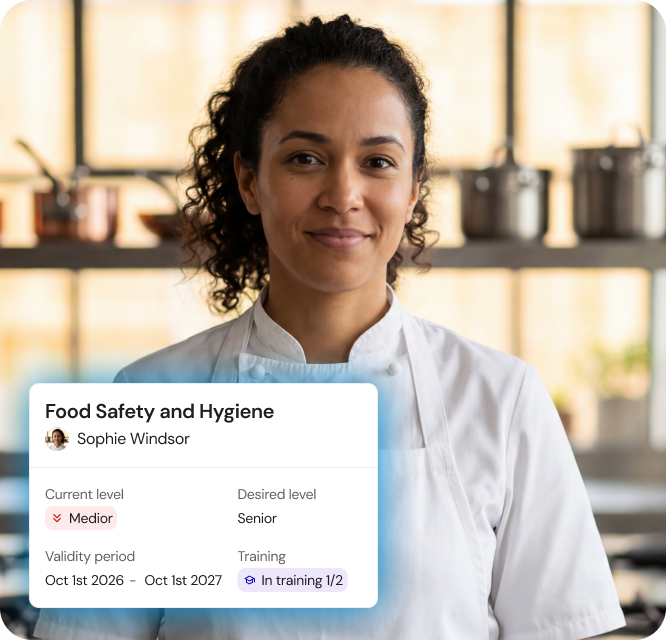
Skills management also changes the way organisations think about development. Where growth often remains abstract, it now becomes concrete. Rather than general feedback or broad development plans, there is clarity about which skills a person has mastered and which can still be developed. This makes development tangible and measurable. Employees gain more direction in their growth. Managers can provide more targeted guidance. And organisations can more effectively steer internal advancement and talent development. As a result, development is no longer a separate process, but a natural part of everyday work.

A new perspective on development

Background glow

The link to workforce management

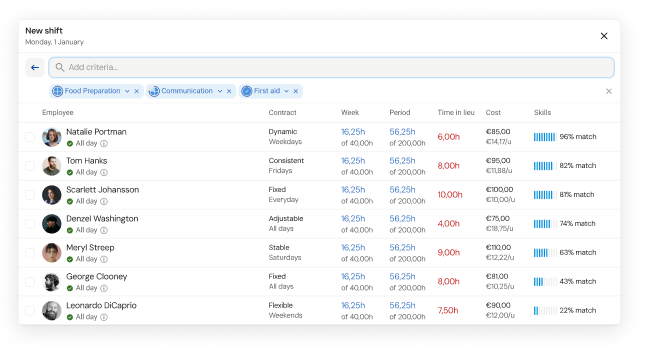
The impact of skills management grows even further when it is connected to workforce management. Where planning has traditionally revolved around availability, skills management adds an extra dimension: deployability. It is not only a question of who can work, but also of who is best suited to a specific task, role, or situation. This leads to better operational decisions and a higher quality of execution.

Over time, this leads to an important development: planning based on skills. This goes beyond looking at staffing levels to also considering the composition of teams and the skills required to carry out work effectively. This makes organisations more agile and better prepared for change.

Background glow

A challenge that many organisations recognise is that information about employees is scattered across various systems and files. Skills management helps to reduce this fragmentation by creating a single central overview. This not only creates efficiency, but also coherence. When skills, performance, and development are connected to one another, a more complete picture of employees and teams emerges. This makes it easier to make consistent decisions and to steer with purpose.

Less fragmentation,
more coherence

Background glow

From insights to impact

Skills management starts with insight, but the real value lies in what you do with it.

Organisations that have a thorough picture of their skills are able to:

  • Respond more effectively to change
  • Develop more purposefully
  • Drive quality and growth more effectively

This shifts the focus from reactive to proactive. Not only resolving what is happening today, but building what is needed tomorrow. And that is precisely what makes skills management so relevant. Not as an additional layer on top of existing processes, but as the foundation beneath how organisations deploy, develop, and grow their people.

The future of Automatic Scheduling

Background glow

You probably know the feeling: spending hours puzzling over schedules, dealing with last-minute changes, and handling employees who are unhappy with their shifts. What if we told you that you could spend that time and energy on what really matters instead? Auto-scheduling does exactly that. So, what is auto-scheduling, and why are more and more organisations choosing it?


How auto-scheduling works in practice

Auto-scheduling means workforce management software creates staff schedules independently. It does this based on fixed rules, real-time data, and clearly defined parameters. Think of available hours, employee preferences, legislation and regulations, and business goals. You set the ground rules. The system does the rest. Planning shifts from manual work to active control. Put simply: your schedule works for you, not the other way around.


The benefits of auto-scheduling

Smart planning is not just about speed. It is about making better decisions. Bringing calm to the organisation. And creating room to look ahead. In practice, this shows up in five clear benefits.

Background glow

1. Time is money, save both

Manual scheduling does not just take up a lot of time. It also demands your constant attention. Every change affects the entire schedule and requires new adjustments. Automating staff scheduling takes that pressure out of the process structurally. You no longer need to carry out corrective work. You schedule faster and with more clarity. That gives you much more room to look ahead and make strategic decisions.

HR departments and managers spend less time putting out fires and more time building a stable organisation. You do not notice that difference once. You notice it every single week.

2. Reliable schedules create peace of mind

It will sound familiar: scheduling errors cause a lot of frustration. Double shifts, forgotten days off, or violations of rest periods. By automatically monitoring agreements and rules, you prevent these kinds of mistakes structurally. Deviations are flagged immediately. The result is a schedule employees can trust. And one managers can confidently rely on. The future of Data Driven Automatic Scheduling is finally here!

3. The right staffing starts with insight

Good scheduling is all about balance. Too many people costs money. Too few people costs quality. With efficient staff scheduling, you align workforce deployment with actual demand and available capacity. This creates a better distribution of work and talent. You avoid structural overstaffing or understaffing. You assign employees where they add the most value. That is how scheduling grows into a strategic tool instead of an administrative burden.

4. More control and more freedom for employees

A schedule only truly works when employees recognise themselves in it. Smart scheduling takes factors such as preferences, availability, and leave into account. Employees know earlier where they stand. They experience more control over their work-life balance. That clarity increases engagement and reduces last-minute changes. A good schedule works for everyone.


5. Control costs without losing flexibility

Inefficient schedules directly lead to higher costs. Think overtime, emergency fixes, or unnecessary staffing. By planning more sharply and consistently, costs become easier to control. At the same time, your organisation remains flexible, because the schedule can quickly adapt to changes. This gives you control over costs without sacrificing agility.

Background glow

Future-proof with AI

The benefits above clearly show the difference. Traditional scheduling is static and depends on individual knowledge. Auto-scheduling is dynamic and data-driven. If demand, availability, or regulations change, your schedule changes with them. Fewer manual adjustments mean fewer errors and more continuity. That makes auto-scheduling not only more efficient, but also future-proof.

Naturally, AI and machine learning also play a major role in auto-scheduling. By analysing historical data, the system recognises patterns and predicts future staffing needs. This creates a schedule that does not just respond to what is happening, but anticipates what is coming next. Workforce management shifts from reactive to proactive.


Let the system do the thinking

Auto-scheduling is not a trend. It is a choice. A fundamental development within workforce management. It helps you save time and reduce costs. It enables you to deploy employees more effectively. It creates calm in daily operations. At Dyflexis, we therefore do not see scheduling as administration, but as leadership. With auto-scheduling, you set the direction while the system does the work. But how do you make that step concrete within your organisation?

Dyflexis helps you put this technology to work for your organisation. With our auto-scheduling solutions, you benefit from countless advantages. Request a demo and quickly discover how to take your scheduling to the next level.

Bigger Together: The story behind our new branding

At Dyflexis, we believe progress never happens alone. Growth happens when technology, people and collaboration come together. That’s why we’re introducing our new brand identity – built around one central idea: Bigger Together.

Our new branding reflects who we are today, what we stand for and where we are heading. It’s more than a visual refresh; it represents our vision on workforce management, talent development and long-term partnerships.

Background glow

Why a rebrand?

Over the past years, Dyflexis has grown significantly. What started as planning and time registration software has evolved into a powerful workforce management platform that helps organisations run their operations more efficiently.

But the world of work is changing rapidly. Organisations are no longer only looking at schedules and hours; they increasingly focus on skills, development and talent.

That’s why we’re taking the next step.

Our new branding supports a broader vision: a platform that helps organisations not only manage their workforce efficiently, but also unlock and develop the talent within their organisation.

Bigger Together: the core of our brand

Bigger Together sits at the heart of our new brand.

It reflects our belief that growth happens when people, technology and organisations strengthen each other. Workforce management is not just about processes or software. It’s about people working together, teams developing and organisations moving forward.

With Dyflexis, we help organisations get the best out of their teams. Not only by enabling smarter planning, but also by providing insight into talent, skills and development.

We believe organisations become stronger when employees are able to grow and use their talents to the fullest. When individual growth and shared success come together, real progress happens.

Bigger Together therefore means more than working together – it means growing together.

From workforce management to talent optimization

The role of workforce management is evolving. Traditionally, it focused on scheduling and time tracking. Today, the focus is shifting towards skills, insights and talent development.

Dyflexis is therefore evolving from a traditional WFM platform into a broader platform that supports both operational excellence and human potential.

Our ambition is clear: helping organisations not only deploy their workforce effectively, but also help their people grow and perform at their best.

In other words, organisations should not only know when someone works, but also what someone can do, what they want to develop and where their potential lies.

“Bigger Together is not a slogan – it’s how we collaborate with customers, partners and our own people.”

A perspective from our CEO

According to Dyflexis CEO Matthijs, this evolution represents a natural next step.

“We are moving from planning to performance. From time tracking to talent optimization. This is not a feature update, it’s a strategic shift.”

Organisations today face new challenges. Labor markets are tight, talent is scarce and employees expect more opportunities to grow.

This makes insight into skills and capabilities increasingly important.

“The future of Workforce Management is not only about when someone works, but about what someone can do. Skills will become the new currency within organisations, and Dyflexis enables that.”

The new branding reflects this direction and clearly communicates where Dyflexis is heading: becoming the platform that helps organisations bring out the best in their people.

“Bigger Together is not a slogan – it’s how we collaborate with customers, partners and our own people.”

The three pillars of our brand

Power
made simple

Workforce management can be complex. Planning, time tracking, communication and integrations all come together in one ecosystem.

Dyflexis simplifies these processes through one powerful and integrated platform. Our technology helps organisations create clarity, streamline operations and enable teams to work more efficiently.

Reducing complexity so organisations can focus on what matters most: people and performance.

Built for
progress

Organisations never stand still. Teams grow, processes evolve and new insights emerge.

That’s why Dyflexis is built to support progress. Our platform provides insights, data and tools that help organisations make smarter decisions and plan ahead.

Not only for today, but also for tomorrow.

Partnership with personality

At Dyflexis, we believe technology alone is not enough. Real success comes from collaboration.

We work closely with our customers and partners to develop solutions that truly make an impact. We listen, think along and continuously improve together.

We’re not just a software provider — we’re a partner that stands beside you.

Together we grow stronger. Bigger Together.

Protect your Dyflexis account against phishing and login fraud: the power of two-factor authentication

In a world where cyber threats are becoming increasingly common, it is essential to properly secure online accounts. In the context of Workforce Management and managing personnel planning and time registration, optimal protection of user accounts is of great importance. One of the most effective methods to strengthen this security is the use of two-factor authentication (2FA).


What is two-factor authentication?

Two-factor authentication (2FA) provides an additional security layer on top of the password. When logging into the Dyflexis account, in addition to entering a password, a second factor is also required. This second factor can vary, such as a code via a telephone, a fingerprint scan, facial recognition, or a physical security key.


Why is two-factor authentication so important?

Protection against phishing

Phishing is one of the most common forms of cybercrime. Here, criminals attempt to steal personal information by posing as a trustworthy entity, such as a bank, employer, or even Dyflexis. Criminals often send emails or messages with a link to a fake login page that is almost identical to the genuine one. After entering login credentials on this page, these details fall directly into the hands of the criminals.

With 2FA, obtaining the password alone is not sufficient. Even if they manage to obtain the password, the second factor is still needed to gain access to the account. This makes it considerably more difficult for them to succeed in their attacks.

Preventing login page fraud

In addition to phishing, mimicking login pages is an increasingly common tactic used by cybercriminals to steal login credentials. These pages resemble the genuine login page of an organisation but are managed by malicious actors. Without 2FA, there is a significant risk that after entering details on such a fake website, the account can be hacked immediately.

With 2FA, after entering the password, a second step always needs to be completed. Since criminals usually do not have access to this second factor, stolen passwords become virtually worthless, even if they have been obtained via a fraudulent login page.


How does two-factor authentication contribute to secure login on Dyflexis?

For users of Dyflexis, 2FA offers a significantly higher level of security when logging into their accounts. This is not only reassuring for users but also for companies that wish to protect their personnel data against unauthorised access.

By enabling 2FA, every attempt to log into the Dyflexis account is validated by both something one knows (the password) and something one has (for example, a unique code that is sent to the telephone). This ensures that even if the password is stolen, the account still remains secure.


Conclusion

In an era when cyber threats such as phishing and fake login pages are becoming increasingly common, implementing two-factor authentication is an essential step to protect your Dyflexis account. By adding an additional security layer, the risk of an account falling into the wrong hands is significantly reduced and company and personnel data remain safe.

At Dyflexis, security is a top priority. Enable 2FA on your Dyflexis account today and experience the peace of mind that comes from knowing that a robust measure has been taken against the growing threats of online crime.

Rotating Rosters with Dyflexis

A well-organised rotating schedule is essential for organisations with rotating shifts, such as manufacturing companies and logistics centres. It ensures that machinery is optimally utilised, production processes run without interruption, and employees don’t become overworked. This not only increases productivity, but also has a positive effect on employee satisfaction and workplace safety. With the right software, you can easily manage schedules, implement changes quickly, and always give employees insight into their working hours. This keeps the organisation running smoothly and efficiently.


Shifts ready? Roll them out!

In our rotating schedule software, you can easily set up your organisation’s shift cycle. This forms the basis of the schedule: teams are assigned to the appropriate shifts, and employees are then linked to these teams. Thanks to this flexible system, you can set up a cyclical schedule simply and clearly, so you always know which employee is working when.


Implement changes easily

It regularly happens that changes are needed during the cycle. An employee needs to swap shifts, a team allocation needs to be adjusted, or there’s a need for additional support. In the rotating schedule module, you can implement these kinds of changes easily. Swap employees between shifts, adjust schedules, and ensure everything is up to date in just a few clicks. This keeps your planning dynamic and suited to the current situation on the workplace.

Visualitatie van de feature

In a manufacturing environment, everything revolves around continuity. Downtime costs money. Yet many managers face the same frustration daily: an employee is scheduled but is nowhere to be found. Or worse still: in the event of an emergency, no one knows who’s on the premises. Sound familiar? Then the new attendance report is exactly what you need.

How technology helps optimise schedules

In Production & Logistics, everything revolves around precision. Raw materials, machinery, vehicles: they are planned and coordinated down to the finest detail. But when it comes to the most important asset, people, things often run less smoothly. That’s precisely where the costs arise. These aren’t directly visible on the balance sheet, but are certainly felt in daily operations.


Absence and Shortage

The logistics sector is under considerable pressure. Research by Dujob reveals that one in three companies cites staff shortages as their greatest challenge. At the same time, sickness absence is worryingly high according to Statistics Netherlands (CBS): the average absence rate in the logistics and transport sector stood at 6.3% in 2024, whilst the average sickness absence in the Netherlands was 4.9% (Dujob, 2024).

What’s particularly striking: no less than 38% of absence in the sector is work-related. This is almost twice the national average of 19%. The combination of irregular shifts, volatile staffing demand, and an ageing workforce makes it increasingly difficult to achieve watertight scheduling. And when that fails, costs, work pressure, and staff turnover only continue to rise (CBS, 2024).

The pressure is also high in the production sector. In 2023, sickness absence here averaged 6.1%, which is considerably above the average in other sectors. In 2024, absence was even the highest within industry, according to ArboNed and HumanCapitalCare. Employees are absent more frequently and for longer periods, partly due to physically demanding work, irregular shifts, and high work pressure. This makes it more difficult to create proper workforce planning.


Growing Complexity

These figures show that many production and logistics companies are struggling with the growing complexity of workforce planning. Changing customer demand, a tight labour market, high absence figures, and staff shortages force organisations to maintain maximum flexibility. At the same time, many schedules remain based on static models, Excel spreadsheets, or outdated systems.

This leads to poor alignment between workload and staff deployment. The consequences are well known: scheduling too many people leads to unprofitable wage costs. Too few available people results in delayed deliveries, stress on the shop floor, and missed deadlines. What’s often overlooked here are the indirect consequences that gradually accumulate. It’s precisely these that have a substantial financial impact. Consider inefficiency in staff deployment, or cost overruns in production due to poor coordination between rosters and workload.

Furthermore, poor workforce planning directly affects motivation. Those who are deployed too often become overloaded. Those who repeatedly have to work unsociable hours quickly feel undervalued. This dissatisfaction translates into reduced commitment, mounting frustration, and ultimately staff turnover.


What Does an Inefficient Roster Cost?

Consider this: an experienced forklift driver is unexpectedly absent. Their fixed gross monthly salary is €2,747, but to keep operations running, a temporary worker is hired. According to Chamber of Commerce guidelines, a temporary worker costs on average two to three times the gross salary. Let’s assume 2.5 times. This means you’ll pay approximately €6,870 for one month’s replacement.

However, it doesn’t stop there. The replacement is new to the shop floor, doesn’t yet know the processes, needs training, and works less efficiently. In the first weeks, a productivity loss of 25% is quite normal. You’re then paying €1,717.50 for work that isn’t completed or is only partially completed. Meanwhile, colleagues are spending time training the new employee – reckon on at least 10 hours’ supervision at €35 per hour, or €350 extra.

Cost Item                           Temporary Worker             Employee
Salary                              €6870                                €2747
Productivity Loss            €1717                                  €0
Supervision                     €350                                  €0
Total                                     €8937                                      €2747

Table: Hidden costs of staff absence

In total, you’ll quickly pay over €8,937 extra for replacing one employee per month. And we haven’t even mentioned the indirect damage yet: stagnation in the logistics process, delayed deliveries, lost customer satisfaction, and increased work pressure on the rest of the team. You won’t see these costs reflected in your roster, but you’ll certainly feel them in your margin.


The Complexity of Planning

Despite all the technological possibilities, almost 40% of companies in logistics and production still work with Excel or other manual planning methods. Why? Because it’s become a habit and because it appears to provide overview. But appearances are deceptive. Excel doesn’t show real-time absence or exceeded contract hours, let alone collective agreement arrangements or unexpected gaps in the schedule. That costs money.

The complexity of workforce planning in Production and Logistics can no longer be captured in spreadsheets or fixed rosters. What appears to be a watertight schedule today is already outdated tomorrow due to absence, rush orders, or unexpected delays. Those who only react when things go wrong are structurally behind the facts. Research by PwC from 2024 emphasises the importance of strategic workforce planning and suggests that organisations can increase their productivity by as much as 30% by improving this (PwC, 2024).


How Workforce Management Makes the Difference

Particularly in a sector where processes are timed to the second, it’s peculiar that workforce planning often happens with so little data-driven approach. Dyflexis’s Workforce Management software brings change to this. The intelligent, real-time planning automatically adapts to the situation on the shop floor. Is someone ill? Does the order flow change? The software anticipates changes: automatically and flawlessly.

Thanks to automatic planning, you prevent under- or over-staffing, limit overtime, and maintain control of your wage costs. Managers no longer need to constantly chase the facts; they adjust proactively based on current data. And perhaps even more importantly: employees regain peace of mind and clarity, which visibly benefits their job satisfaction and your staff retention.

By cleverly combining current data such as absence, order volumes, seasonal influences, and contractual agreements, you have a dynamic Workforce Management model that continuously adjusts. This approach provides greater efficiency in staff deployment, allowing you to respond better to changing circumstances without incurring unnecessary costs. The result? Fewer surprises, better control, and a way to structurally reduce your wage costs without compromising on quality or job satisfaction.

Are you curious how Dyflexis can help your organisation regain control of personnel, costs, and continuity? Request a demo and experience the difference.

Why our implementation approach works so well

System implementation can feel like an enormous challenge: the pressure is high, deadlines are looming, and you need to get the entire organisation on board with a new way of working. Without the right guidance and expertise, it can feel like you’re groping in the dark. It’s frustrating when you don’t know whether you’re on the right track, or when the implementation doesn’t deliver the desired results.

At Dyflexis, we guarantee the following: Our implementation isn’t a standard process, it’s a personal journey that we undertake together with you. We ensure that your organisation doesn’t just receive the system, but actually embraces and uses it effectively. Our consultants remain at your side until the second payroll run, so that everything works perfectly from the start. No worries about uncertainties, no doubts about progress, just an implementation that stands firm from beginning to end.


Industry experts at your service

We don’t work with general consultants, but with experts who have in-depth knowledge of your sector. Whether it concerns collective labour agreements, allowances or other industry-specific regulations, we understand what’s at stake in your field.

Our experts have years of experience in the market and can provide you with valuable insights that go beyond just software. This makes us a valuable partner who genuinely contributes to the success of your organisation.


“At Dyflexis, our goal isn’t just to implement software, it’s to help our clients build a future-proof workforce management strategy.” – CCO Patrick van der Geest


After implementation, we remain actively involved. Whether it concerns onboarding new managers, adjusting settings due to changes in collective labour agreements or continuing to improve your processes, we keep supporting you.

Change Management

Implementing new software often means that a cultural change takes place within your organisation. That’s why we pay considerable attention to change management. The success of Dyflexis doesn’t just depend on the technology, but also on adoption by your employees.

Our consultants ensure that your employees not only know how to use the software, but also become motivated to actually embrace it. We help enthuse and engage your team, so that they fully commit to the success of the new solution.

Training sessions can be held both online and offline. Our knowledge base and eLearning environment ensure that your team always has the necessary tools and information to make optimal use of Dyflexis.

The power of data

Our support within ProExpert can offer crucial insights. Thanks to advanced AI-driven forecasting modules, we can make accurate labour demand calculations, whereby processes are automated and important insights become available for your organisation.

This data-driven approach delivers crucial insights that can help your organisation not only to plan more efficiently, but also to think more strategically and make decisions that contribute to long-term growth.


“The insights you gain with Dyflexis aren’t just data, they’re opportunities for your business to grow smarter and faster.” – CCO Patrick van der Geest


Conclusion: Dyflexis as your future partner

Dyflexis isn’t just a software supplier, we’re a strategic partner who thinks alongside you and helps you tackle the challenges of the future. With our personal guidance, in-depth industry knowledge, continuous optimisation and AI-driven insights, we ensure that your organisation is capable of achieving success both today and tomorrow.

Data Driven planning retail

Staff scheduling in retail is more complex than ever. Customer flows are becoming more unpredictable, margins are under pressure, and each branch has its own dynamics. Many retailers still rely on experience and gut feeling, but this quickly leads to inefficiency, higher costs, and dissatisfied employees. Want to know how to become efficient and save costs through data-driven planning?

In our e-book Data Driven Retail, you’ll discover how data-driven workforce management helps retailers make better decisions at the click of a button. By combining sales forecasts, customer behaviour, labour costs, seasonal influences, and even weather predictions, you create a schedule that is not only more accurate but also proactively responds to what’s happening tomorrow. That means: less waste, more control, and higher service quality in your store.

You’ll read how retailers are making great strides with real-time dashboards, predictive insights, and a centralised way of managing that actually works for every location. Moreover, the e-book shows how modern technology creates space for personal attention: for customers and for employees who benefit from fairer rosters and fewer last-minute changes.

Want to know how data-driven planning helps you get a grip on labour costs, deploy employees more efficiently, and improve your customer experience? Then read our e-book.

Data-Driven Workforce Management

In the current business context, characterised by its dynamics and complexity, effective Workforce Management is crucial to achieving optimal productivity and controlling expenses. Future-orientated organisations benefit from a data- driven approach to staffing and personnel management, a strategy that Dyflexis has developed. This approach is based on two core principles: Auto-Scheduling and Labour Demand Forecasting.


1. Labour Demand Forecasting – Always the right people at the right time

The tool for forecasting labour demand developed by Dyflexis  is a valuable asset for any organisation that wants to improve its  workforce planning strategies. By using a proactive approach, this tool analyses historical data and market trends to predict future staffing requirements with a high degree of accuracy. Consequently, companies are able to predict periods of peak demand, seasonal fluctuations and bottlenecks ensuring that they are always equipped with the relevant staff at the optimal time.

Key benefits:

  • Improved workforce planning with data-driven insight:  Workforce planning is improved with data-driven insights, which enables informed decisions to allocate resources optimally.
  • Optimised efficiency through the prevention of bottlenecks: Under- and overstaffing is prevented through optimal labour demand forecasting, and smooth operations are ensured by effectively managing fluctuations in staffing needs.


2. Auto-Scheduling – Smart, Seamless, Efficient

Using an Auto-Scheduling tool has proven to be very effective in guaranteeing the right person is planned into the right shift. By utilising advanced data analysis and intelligent algorithms, Dyflexis generates schedules and assigns shifts that are in perfect adaptation with the needs of the company and of its workforce.

The system’s capacity to analyse availabilities,  individual skills, contracts and preferences ensures that the staff schedules generated are not only effective but also optimal. This approach eliminates the financial and operational concerns associated with over-  and understaffing, and so  improves the operational efficiency. The result is a workforce that is not only more productive, but also happier with their performance and work environment.

The benefits of using an Auto-Schedule tool include:

  • Significant gains in efficiency in comparison with manual planning
  • Reduction in administrative workload
  • Improvement in accuracy and optimisation of resource allocation
  • Improvement of employee satisfaction through fair and balanced shift distribution

Why Choose Dyflexis? 

Dyflexis is a sophisticated software solution that has been developed for the specific purpose of enhancing the efficiency and performance of Workforce Management in the following sectors:

By intuitively combining Auto-Scheduling with precise Labour Demand Forecasting, Dyflexis offers an integrated solution that revolutionizes the way you manage your workforce. Our system  is a powerful yet user friendly tool that is capable of driving meaningful improvements in across your entire organization and sector.