Organisations that grow, will sooner or later face the same question: how do you ensure that your employees are not only deployed efficiently, but also utilised to their full potential? At first, this seems straightforward. You know your team, you understand what people are good at, and you distribute work based on experience and instinct. But as teams grow, roles evolve and the pressure to deliver quality increases, this becomes increasingly difficult. That is when the need for something different arises: oversight. Not just in planning, but in skills. And that is precisely where skills management comes into play.

In many organisations, a great deal of information about employees is already available. Think of contracted hours, availability, job roles, and performance. But one crucial element is often missing or fragmented: a clear picture of skills.
- Which skills are present within the team?
- At what level are they mastered?
- And how does that relate to what the organisation needs?
Without that insight, a large part of your workforce remains underutilised. Not because people are incapable of more, but simply because it is not visible. Skills management makes it visible. It brings structure to something that is often implicit. It translates knowledge and experience into concrete, actionable insights. And that forms the foundation for better decisions.
From an overview of people to insight into skills
Why skills management makes organisations stronger
When organisations have a thorough picture of their skills, the way they make decisions changes. Decisions become less reliant on gut feeling and more grounded in insight. Managers gain a clearer view of their team. HR can direct development more purposefully. And operations can better assess where risks or opportunities lie. This is reflected across multiple aspects of the organisation. Teams are assembled more effectively, because it is clear which skills complement one another. Employees are deployed more purposefully, leading to improvements in both quality and efficiency. And development gains more direction, because it becomes visible where growth is possible.
Perhaps even more importantly: talent becomes more visible. In many organisations, employees are capable of far more than their current role reveals. Once that insight is available, new opportunities arise for advancement, broadening of responsibilities, and more effective deployment.

One of the greatest changes that skills management brings about is that implicit knowledge is made explicit. Where managers previously relied on experience (“I know who can handle this”), there is now a shared and more objective picture. This not only creates greater consistency, but also enables better collaboration between departments and locations.
It makes organisations less dependent on individual knowledge, and therefore more scalable. At the same time, it becomes easier to look ahead. When you know which skills are present and which are lacking, you can steer towards the future more purposefully. For example, by investing in training in a timely manner, by developing internal talent, or by recruiting in a targeted way.
From gut feeling to concrete direction
Skill gaps as a compass for growth
A key component of skills management is insight into skill gaps: the difference between the skills you have and the skills you need. That insight acts as a compass. It shows where the organisation can grow and where it may be vulnerable. Not only at an individual level, but particularly at team and organisational level as well. Rather than reacting when something goes wrong, you can take a proactive approach. You know where reinforcement is needed, where knowledge is too narrowly distributed, and where development will have the greatest impact. This makes skills management not only a tool for today, but also a foundation for sustainable growth.
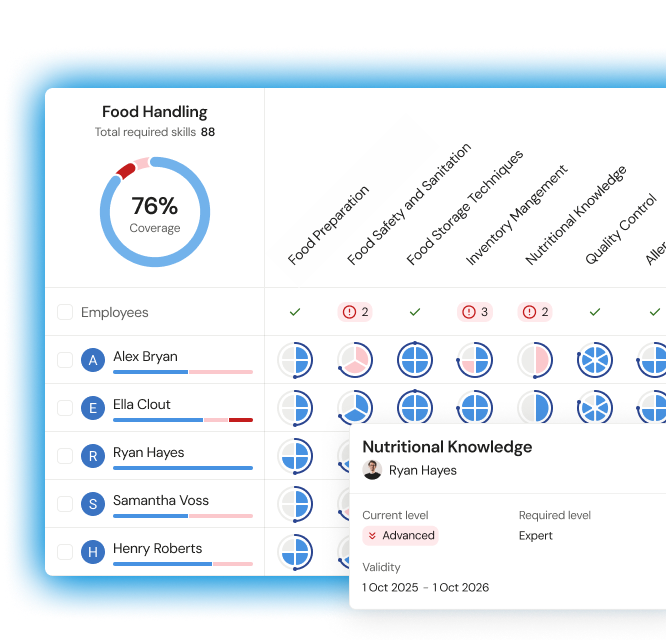
Skills management also changes the way organisations think about development. Where growth often remains abstract, it now becomes concrete. Rather than general feedback or broad development plans, there is clarity about which skills a person has mastered and which can still be developed. This makes development tangible and measurable. Employees gain more direction in their growth. Managers can provide more targeted guidance. And organisations can more effectively steer internal advancement and talent development. As a result, development is no longer a separate process, but a natural part of everyday work.
A new perspective on development
The link to workforce management
The impact of skills management grows even further when it is connected to workforce management. Where planning has traditionally revolved around availability, skills management adds an extra dimension: deployability. It is not only a question of who can work, but also of who is best suited to a specific task, role, or situation. This leads to better operational decisions and a higher quality of execution.
Over time, this leads to an important development: planning based on skills. This goes beyond looking at staffing levels to also considering the composition of teams and the skills required to carry out work effectively. This makes organisations more agile and better prepared for change.
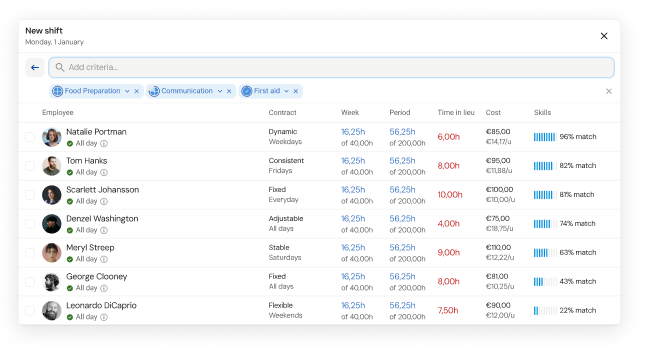
A challenge that many organisations recognise is that information about employees is scattered across various systems and files. Skills management helps to reduce this fragmentation by creating a single central overview. This not only creates efficiency, but also coherence. When skills, performance, and development are connected to one another, a more complete picture of employees and teams emerges. This makes it easier to make consistent decisions and to steer with purpose.
Less fragmentation,
more coherence
From insights to impact
Skills management starts with insight, but the real value lies in what you do with it.
Organisations that have a thorough picture of their skills are able to:
- Respond more effectively to change
- Develop more purposefully
- Drive quality and growth more effectively
This shifts the focus from reactive to proactive. Not only resolving what is happening today, but building what is needed tomorrow. And that is precisely what makes skills management so relevant. Not as an additional layer on top of existing processes, but as the foundation beneath how organisations deploy, develop, and grow their people.