
Employing capacity utilisation to optimise staff scheduling

Good staffing capacity utilisation ensures that you do not face understaffing or overstaffing. The result is that production flows are deployed optimally, with the right amount of people in the right place. And that, in turn, is good for the company’s bottom line. What are the risks of under- and overstaffing, and how do you determine the right level of capacity utilisation? We will explain in more detail!


What is occupancy rate?

Capacity utilisation is the degree of production capacity utilised during a given period. It is expressed as a percentage from 0% to 100%. The ideal utilisation rate is 100%, although in practice this is unlikely to be the case. You can face underutilisation and overutilisation. Through good Workforce Management software, you can organise and optimise capacity utilisation as best as possible.


What is underutilisation?

Underutilisation means that there is more work than staff. In other words, there are too few employees to do the work. This can come from poor planning and sick employees (or from not being able to get staff). Structural understaffing leads to high workload, which in turn can lead to absenteeism (burnout). This ultimately hits the bottom line, which is why understaffing should be avoided as much as possible.


What is overstaffing?

Are there too many employees for the tasks? Then overutilisation is precisely what happens. For a short period of time, this is often not so bad, because overdue jobs can be cleared and stock can be built up. In contrast, structural overstaffing carries risks. Employees get bored, and as an employer you pay unnecessarily high personnel costs. That makes overstaffing undesirable.


How to calculate capacity utilisation?

To calculate staff utilisation, you need two values. The planned hours and the hours needed to meet the desired capacity and quality. Then you do the following calculation, which is more optimal the closer it is to 100%.

(planned hours / required hours) x 100 = utilisation rate (%)


Using capacity utilisation in staff planning

As you have read, it is important to aim for an optimal utilisation rate. This is harder said than done, because sometimes you have to deal with unexpected factors. For instance, there may suddenly be a peak or quiet period, employees may want a holiday during an undesirable period or they may fall ill (unexpectedly) for an extended period. Fortunately, there is something you can do!

Based on historical data from the past, it is possible to make predictions. Based on a Workforce Management System, you know how to predict peak and off-peak times based on past data. And so you know when it is time to bring in extra staff and when that week off is just right.


Optimal utilisation with Dyflexis forecasts

Making such predictions (forecasts) is difficult without proper registration. It is therefore smart to use planning and capacity management software. Such a system records everything for you, from leave requests to illnesses, peak moments in the past, et cetera. This information serves as the basis for creating a staff schedule with the ideal capacity utilisation.

Dyflexis offers an efficient personnel system, which can help determine the ideal occupancy rate.

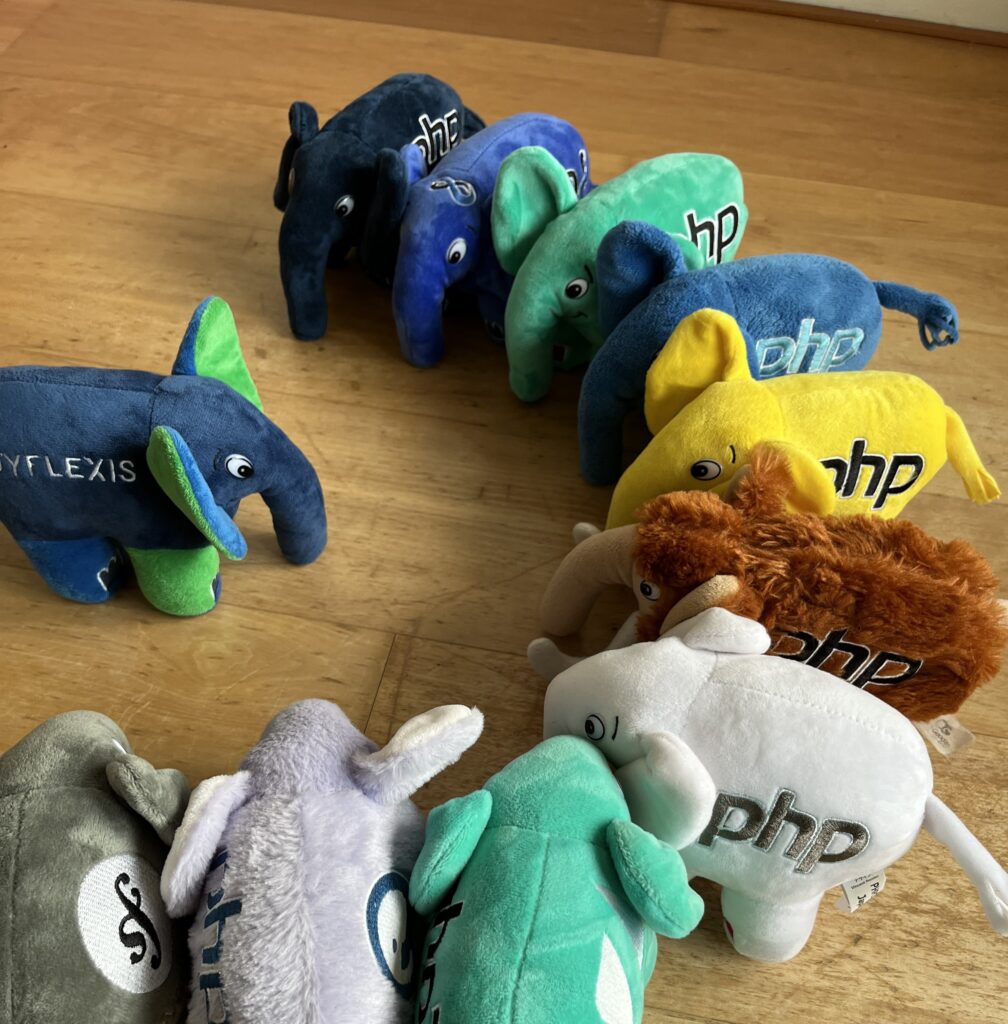
The story behind the Dyflexis Elephant, DyflexiPHPant


You might have come across it: the Dyflexis elephant, named DyflexiPHPant. But DyflexiPHPant is more than just a cute stuffed animal; it has a loyal following of thousands of people and has traveled all over the world. How did this charming elephant manage to achieve that?


The family of DyflexiPHPant

DyflexiPHPant is part of a large herd of elephants, each unique in their colors but all sharing the same symbolic values: strength, reliability, and flexibility. Where do these traits come from?


The growth of the herd in 1998

DyflexisPHPant, het PHP-olifantje, omringt door zijn vriendjes


Software developer François Buffière discovered the programming language PHP. He was immediately enthusiastic about its potential and predicted it would become a revolutionary programming language. François was so passionate about PHP that he couldn’t stop talking about it. During one of his enthusiastic talks, his friend Vincent Pontier started sketching the letters ‘PHP.’ He discovered that, viewed from a certain angle, the letters formed the shape of an elephant. Thus, the first PHP elephant was born.

Years later, PHP has grown to become one of the most popular programming languages in the world, known for its strength, reliability, and flexibility. PHP has a large and dedicated following worldwide, and from this community, thousands of PHP elephants have emerged. These elephants have become coveted collectibles at global PHP conferences.


Dyflexis is entirely written in PHP

We couldn’t miss out on this trend. At Dyflexis, we are even at the forefront of PHP developments. This enables us to build a powerful, reliable, and flexible Workforce Management solution. Over 4500 customers use Dyflexis, and we offer dozens of integrations.

Do you want a DyflexiPHPant too? Visit us at our office or see us at one of our trade shows and take a piece of this unique family home with you.


Dyflexis introduces Single Sign On

In today’s digital world, switching through various applications and platforms is part of the daily work routine. We know that managing all these login credentials can become a challenge at times. This is why Dyflexis is officially introducing the new Single Sign-On feature.


Single Sign-On as the essential link

Single Sign-On, or SSO, allows users to stay logged in to multiple applications while using just one set of login credentials. This is done by the SSO software, which automatically handles logging into other applications with the use of an identity provider.

This identity provider is linked to, for instance, a Microsoft or Google account. Logging into this account then creates a direct link and automatically grants access to your other connected applications.


What are the benefits of SSO?

  • Ease of use: Users only need to remember one set of login credentials, simplifying and speeding up the login process.
  • Increased productivity: Less time spent logging in means more time for actual work.
  • Enhanced security: By reducing the number of login credentials, SSO lowers the chance of unsafe password practices.
  • Efficient access management: Administrators can easily manage which users have access to which applications from one central point.
  • Secure sensitive data: Prevent employees who are no longer with the company from accessing sensitive data. If an employee leaves, you can manage access to connected applications through the identity provider.
  • Less IT support: With fewer forgotten passwords to reset, IT teams can spend their time on more important tasks.


Which identity providers does Dyflexis offer?

Dyflexis supports the largest identity providers, such as:

  • Azure (Microsoft)
  • Okta (Google)
  • Auth0 (Google)
  • Salesforce

Check out our Marketplace for all available options.

Most organizations use Google or Microsoft for Single Sign-On. If you do not use these systems, contact us to discuss the possibilities by emailing sales@dyflexis.com.


How does the implementation work?

Implementing SSO is a breeze. After you subscribe to our service, API keys will be available in Dyflexis. Enter these into the identity provider, and just like that; SSO is set up!

Do you need help setting up SSO? One of our consultants will be happy to assist you.


Do you want to use SSO?

SSO might already be included in your current subscription. Send an email to sales@dyflexis.com to request it.