Planning your workforce is important. But real progress only comes when you also know who is performing well, who is ready for a next step, and who contributes positively to collaboration within the team. That is precisely where the 9-grid helps. It provides a visual overview of your employees, enabling you to steer development, succession, and how people are deployed across the organisation.

What is the 9-grid model?
The 9-grid is an assessment model with which you assess employees on two dimensions. Based on that assessment, employees are visually distributed within a matrix, so you can quickly see how someone is developing and how they compare to others within the team. The aim of this assessment is to provide a clear picture of strengths, development opportunities, and areas for attention. In this way, the 9-grid is above all a practical conversation tool for targeted development discussions and better decision-making on the shop floor.
The model was developed by McKinsey to give organisations a strategic tool for gaining insight into employee performance. This traditional 9-grid model looks at performance versus potential. Dyflexis has developed a variant of this that is better suited to non-desk and frontline employees: performance versus attitude & behaviour. This means you look not only at what someone achieves, but also at how they collaborate, take responsibility, step in when needed, and contribute to stability and reliability within the team.
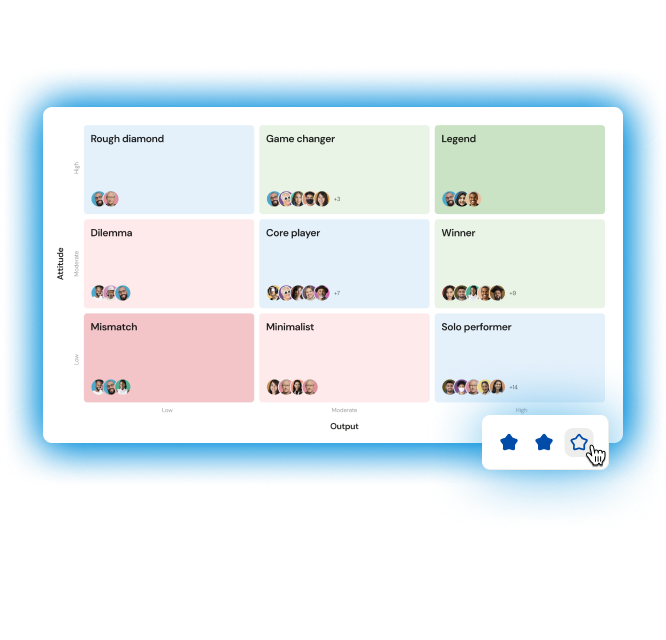
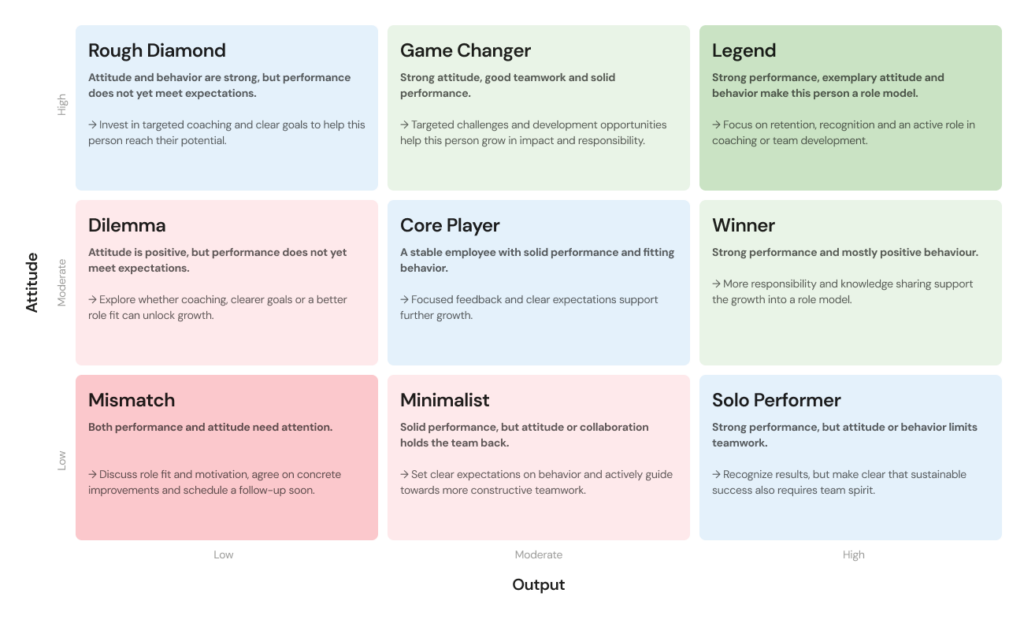
Both axes have three levels: low, average, and high. This creates nine boxes. The second axis is deliberately different from the traditional model. For many frontline roles, ‘potential’ is difficult to assess objectively, whereas attitude and behaviour are visible every day. They manifest in practice: keeping to agreements, supporting colleagues, remaining reliable during peak moments, radiating calm, taking responsibility, and fitting in with the way the team works together. This is not without consequence; it has a direct impact on performance, team dynamics, and the customer experience.
Performance: how does the employee perform?
Attitude & Behaviour: collaboration and role within the team
What can I use the 9-grid for?
You use the 9-grid to make talent concrete and open a discussion. It supports talent management, succession planning, development conversations, and making targeted decisions about coaching, training, or progression. Because you visually categorise employees, you can more quickly see where growth potential lies, where risks exist, and where you have reliable people on whom you can depend.
The real strength lies in the combination of the model and the conversations it prompts. The model does not help you to “box people in”, but to ask better questions. Is someone performing well, but causing friction within the team? That is not a minor detail, but relevant management information. And is someone not yet delivering the highest results, but working reliably, learning quickly, and strengthening the group? Then there may be considerable potential there.
How do you use the 9-grid in practice?
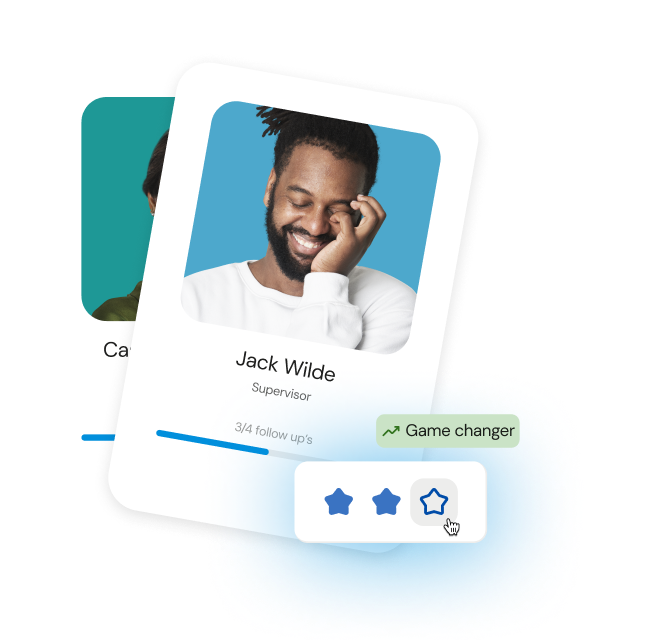
In practice, managers do not work by manually placing employees into a box in the 9-grid themselves. Instead, they provide an assessment for each employee on the two axes: performance and attitude & behaviour. For both dimensions, they give 1, 2, or 3 stars. Based on these scores, the employee is automatically placed in the correct box of the 9-grid.
This makes the model accessible and quick to use. Managers do not need to write extensive explanations or lengthy assessments on paper, but can simply record their assessment in a straightforward way. That is precisely a major advantage in practice: it takes little time, is easy to complete, and produces a clear, visual overview of the team.
The strength of the 9-grid lies not only in the outcome, but above all in the conversations that follow. The scores and position in the matrix form the starting point for discussions between managers and employees about performance, attitude, collaboration, development, and possible next steps. By repeating this periodically, you can also clearly track how employees are developing and whether they shift position within the matrix over time.
The strength of the 9-grid lies not in the outcome, but in the conversations that follow.
What are the benefits of the 9-grid?
Simple assessment:
no paperwork
Managers can assess employees quickly without lengthy forms, extensive reports, or separate notes. By giving a score for performance and attitude & behaviour, a clear picture emerges straight away. This saves time and makes the assessment process accessible enough to carry out on a regular basis.
A complete overview of the organisation
By looking at performance and attitude & behaviour, you gain a more complete picture of employees, teams, and departments. You can see not only who is performing well, but also who contributes positively to collaboration. In this way, you gain a grip on the quality of an entire department or even the whole organisation in a single overview.
Discover the
changes and gaps
Because the 9-grid is quick and straightforward to complete, you can repeat the process more frequently. Some organisations do this every quarter. As a result, you can more quickly identify which employees are developing, falling back, or in need of extra attention. This allows you to intervene earlier and have more targeted conversations.
Would you like to use the 9-grid successfully within your organisation? We would be happy to speak with you to work together on an approach that suits your teams and way of working.