
Shift work is essential for many organizations, but it brings unique challenges. Constantly changing working hours can lead to more fatigue and affect employee well-being. To ease this burden, ATV days (arbeidsduurverkortingsdagen, or working time reduction days) are a valuable tool. These paid days off, often set out in collective labor agreements (CAOs), help employees recover and give organizations the chance to create a healthier balance between work and private life.
Dyflexis makes scheduling shifts more efficient than ever. With our intuitive shift scheduling software, schedulers can quickly optimize schedules, taking rest and working times into account. This not only supports compliance with the law, but also improves team productivity and satisfaction. Because in the end, it's not just about working, but also about living. In this article:
What is shift work?
Benefits of shift work
2-shift work and the 2-shift schedule
3-shift work and the 3-shift schedule
4-shift work and the 4-shift schedule
5-shift work and the 5-shift schedule
The Dutch Working Hours Act
Easily scheduling shifts with Dyflexis
What is shift work?
A shift system is a schedule made up of several shifts. These shifts often consist of an early shift, a late shift and a night shift. Employees work at variable times and on variable days, but according to a fixed pattern that keeps repeating. Shift work is often used in organizations where work has to continue for longer than the usual 8 hours. You regularly see this in manufacturing and in care, for example.
Shift systems aren't always set up the same way. But some shift systems are common, such as 2-, 3-, 4- and 5-shift systems.
Benefits of shift work
Working in shifts has a number of important benefits:
It provides a high degree of predictability and regularity. That's pleasant for your employees.
Because of the repeating pattern, you make mistakes less easily.
If you work with shifts, it's inevitable that your employees work irregular hours, but by setting them up in a smart way, they're bothered by it as little as possible. Why??? Predictable. Already know when I have to work, fixed rhythm, clear for employees.
2-shift work and the 2-shift schedule
The 2-shift schedule is common in organizations that want to reach an operating time of about 80 hours per week. In general, there's no weekend work with this schedule. It consists of early and late shifts.
How does 2-shift work work?
There are different variants of the 2-shift system. A few examples, each with its own benefits:
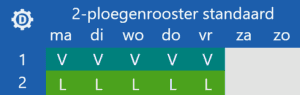
The standard 2-shift schedule
With a standard 2-shift schedule, the employee first works five early shifts and then five late shifts, after which this repeats.
The fast-rotating 2-shift schedule
As the name says: with the fast-rotating 2-shift schedule, the employee switches shifts faster. Think of two or three early shifts alternated with two or three late shifts. This makes the late shift less of a burden on the employee's social life.

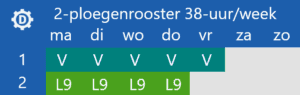
38-hour 2-shift schedule With the 38-hour 2-shift schedule, the employee works 38 hours per week. One week, the employee works five early shifts of 8 hours a day. The week after, they work four late shifts of 9 hours a day. The socially important Friday evening is free.
2-shift allowance
With this shift schedule, an employee usually receives a shift allowance of 8-12% over the entire shift.
3-shift work and the 3-shift schedule
The 3-shift schedule is often used by organizations that also need staffing at night. In this case, three 8-hour shifts usually take turns. That way, an organization can staff 24 hours a day. In general, work runs from Monday to Friday when an organization uses a 3-shift schedule.
How does 3-shift work work?
There are different variants of the 3-shift system. A few examples:
Rotating 3-shift schedule A rotating 3-shift schedule can rotate forward or backward. This means the shift starts earlier each time (night - late - early) or later each time (early - late - night).


Rotating 2-shift schedule with a fixed night shift
Some organizations also use a 2-shift schedule and work with a fixed night shift. Sometimes a fixed weekend shift is added as well.

3-shift allowance
With this shift schedule, an employee usually receives a shift allowance of 15-20% over the entire shift.
4-shift work and the 4-shift schedule
Does production also have to continue on weekends? Then the 4-shift system is sometimes chosen. With this schedule, Sunday is usually free of work.
How does 4-shift work work?
There are different variants of the 4-shift system. A few examples:
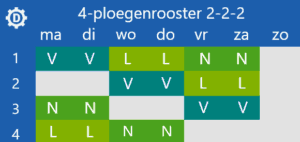
4-shift schedule 2-2-2
With the 4-shift schedule 2-2-2, the employee alternately works two early, late or night shifts.
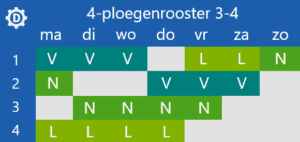
4-shift schedule 3-4
With the 4-shift schedule 3-4, the employee always works a series of at least three and at most four shifts in a row. These are usually the same kind of shift.
4-shift allowance
With this shift schedule, an employee usually receives a shift allowance of 23-27% over the entire shift.
5-shift work and the 5-shift schedule
When an organization needs staffing seven days a week, 24 hours a day, the 5-shift schedule is often used. With this schedule, the average working time per employee is about 33.6 hours. Many employees like this way of working because of the short work weeks and high allowance. Sometimes it's necessary to work in 6- or even 7-shift systems. Shift schedules are also sometimes combined.
How does 5-shift work work?
There are different variants of the 5-shift system. A few examples:
5-shift schedule 2-2-2
With a 2-2-2 schedule, an employee first works two early shifts, then two late shifts and then two night shifts. They then have four days off.

5-shift schedule 3-2
With a 3-2 schedule, the employee works the same shift for three days. After that, they have two days off.

5-shift allowance
With this shift schedule, an employee usually receives a shift allowance of 28-33% over the entire shift.
The Dutch Working Hours Act
If you start working in shifts, it's important to take the Dutch Working Hours Act (ATW) into account. The following rules are important:
Employees aged 18 and older may work a maximum of 12 hours per shift and a maximum of 60 hours per week.
With a three-shift schedule (with a night shift), an employee may work a maximum of 10 hours per night (between midnight and 6:00 a.m.).
Over any 16 weeks, an employee may not work more than 48 hours per week on average.
Does an employee work more than 16 night shifts per 16 weeks? Then they may work a maximum of 40 hours per week.
Per 16 weeks, an employee may work a maximum of 36 night shifts, unless joint agreements have been made about this
Easily scheduling shifts with Dyflexis
Are you going to work with shifts? Then creating a good schedule can still be quite a challenge. In Dyflexis, we've built in handy features that make it as easy as possible for you.
Comply with the Working Hours Act
Dyflexis has built-in rules, so you can't schedule your employees for too long. That way, you always comply with the Working Hours Act.
Create a standard schedule once and roll it out easily
With Dyflexis, creating a staff schedule doesn't have to take much time:
Create a standard schedule for each cycle week. You can already schedule employees on the shifts in this schedule, but you can also add open shifts.
Choose per week which standard schedule you want to roll out. That also makes it easy to skip a week when you're closed.
Still want to change something? Of course you can. Handy when extra shifts are needed in a certain week or when an employee is sick or on leave.
When you roll out a schedule, the shifts of sick employees or employees on leave automatically become open. That way, you quickly see which shifts still need to be filled.
Fill open shifts easily
Are there shifts you haven't scheduled anyone for yet? Then you can send your employees a push notification. They can then indicate whether they can fill the open shift. You then pick the most suitable employee. With labels and conditions, you make sure only employees with the right skills and certificates can respond to the open shift.
Quickly see how much capacity you need
When you're scheduling, you see important information lines at the top of your day. Think of expected revenue, orders placed and the weather. Through our API, you can also push other important information into Dyflexis, such as the expected number of units to produce. That way, you easily estimate how much capacity you need and can adjust your schedule accordingly.
Want to know more about Dyflexis and shift work? Request a demo and we'll be happy to show you.


Discover the power of Dyflexis
Pick a time that works for you.
Free and without obligation, read how we handle your data in our privacy policy.


